Skip to Content

A different view of how we could live.

Explore the vision
01

The Vision

What if the places we built gave us more of the world instead of replacing it?

Build Up.
Give Back.

What if we built up so nature could spread out?

For generations, we have built communities outward. Homes, roads, parking lots and infrastructure spread across the landscape, dividing people from one another and nature into smaller and smaller pieces.

Sharing the View imagines another possibility: concentrate the places we live while leaving far more of the landscape continuous, connected and alive.
A Better Life.
Not a Sacrifice.

A more sustainable future should also be a more desirable one.

The goal is not to persuade people to accept smaller lives for the sake of the planet. It is to ask whether living differently could actually give us more: more nature, more freedom, stronger communities, extraordinary views and places designed around human beings instead of automobiles.

If a more sustainable future feels like a sacrifice, we haven't imagined a good enough future.

Density Without
Confinement.

Living closer together should give us more space, not less.

Density usually brings to mind apartment towers, crowded streets and windows looking into other windows. But concentrating homes vertically could instead make room for private gardens, greenhouses, trails, forests and enormous shared landscapes.

The purpose of building upward isn't to fit as many people as possible into a tower. It is to occupy less of the Earth while giving each person greater access to it.

Private Lives.
Shared Possibilities.

Community doesn't have to come at the expense of independence.

Families can have substantial private homes and private outdoor spaces while sharing the things that become extraordinary at a community scale: rooftop parks, large greenhouses, recreation spaces, transportation, workshops, energy systems and miles of surrounding landscape.

Children and parents, grandparents and grandchildren, friends and neighbors can live near one another without having to live on top of one another.

The best things don't always have to belong to one person for everyone to enjoy them.

Imagine
First.

Our mission is not to predict the future. It is to help people imagine a better one.

Sharing the View is not a finished blueprint, and it isn't an argument that every community should look exactly like these images.

It is an open vision for architects, engineers, planners, builders, researchers and ordinary people willing to question assumptions we have inherited about what a home, a neighborhood or a city has to be.

We don't expect this exact vision to be the answer. We hope it helps someone imagine an answer.

02

The Canopy

The best view in the building belongs to everyone.

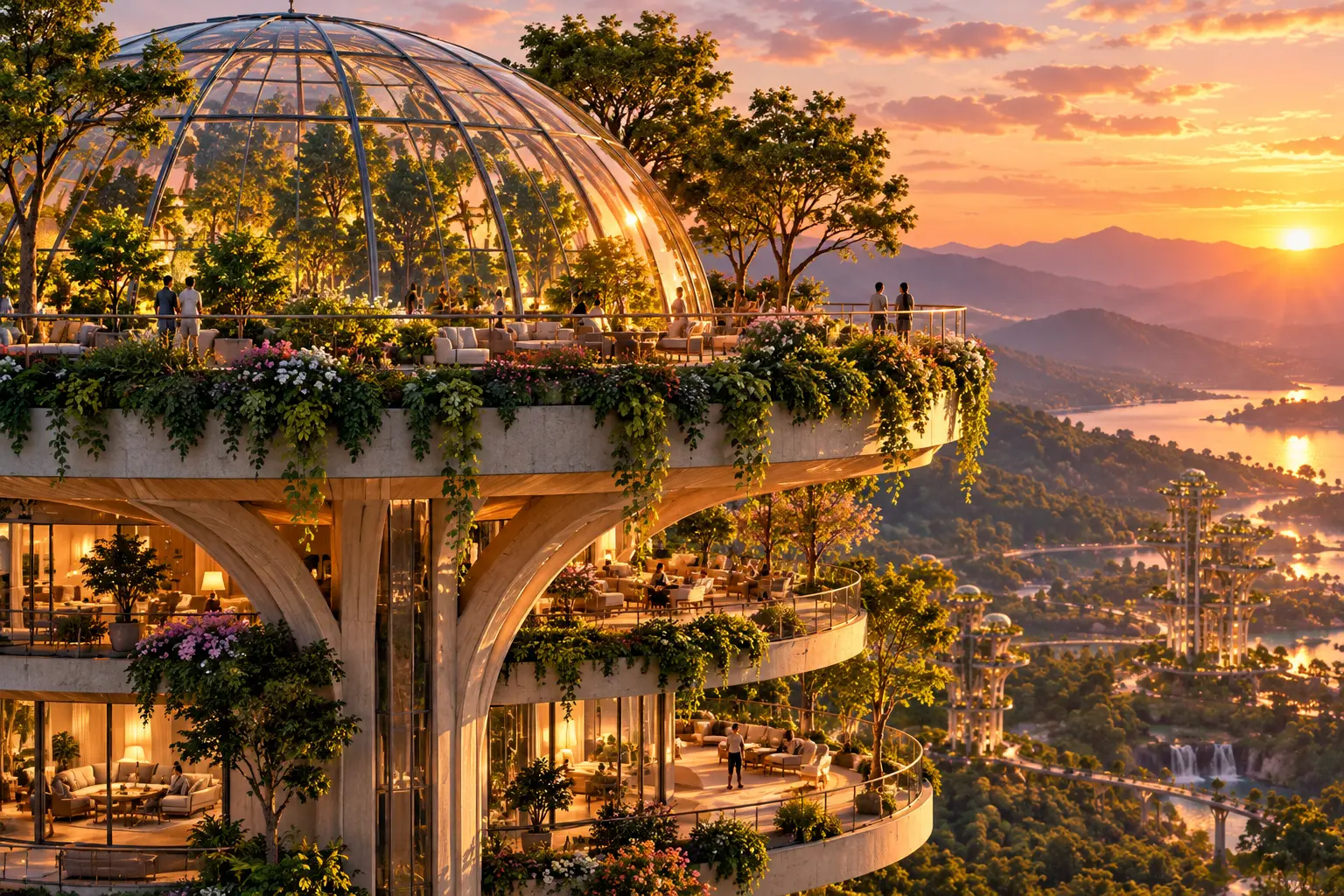
At the top, the structure opens into a shared landscape: trees, gardens, places to gather, places to play and a greenhouse beneath an unobstructed sky.

Instead of reserving the highest level for a private penthouse, the canopy becomes the community's backyard. It is a place for celebrations, quiet mornings, food growing and simply watching the world beyond.

The higher we build, the more important it becomes that access to the sky remains communal.

03

The Branches

Real homes, surrounded by living space in every sense.

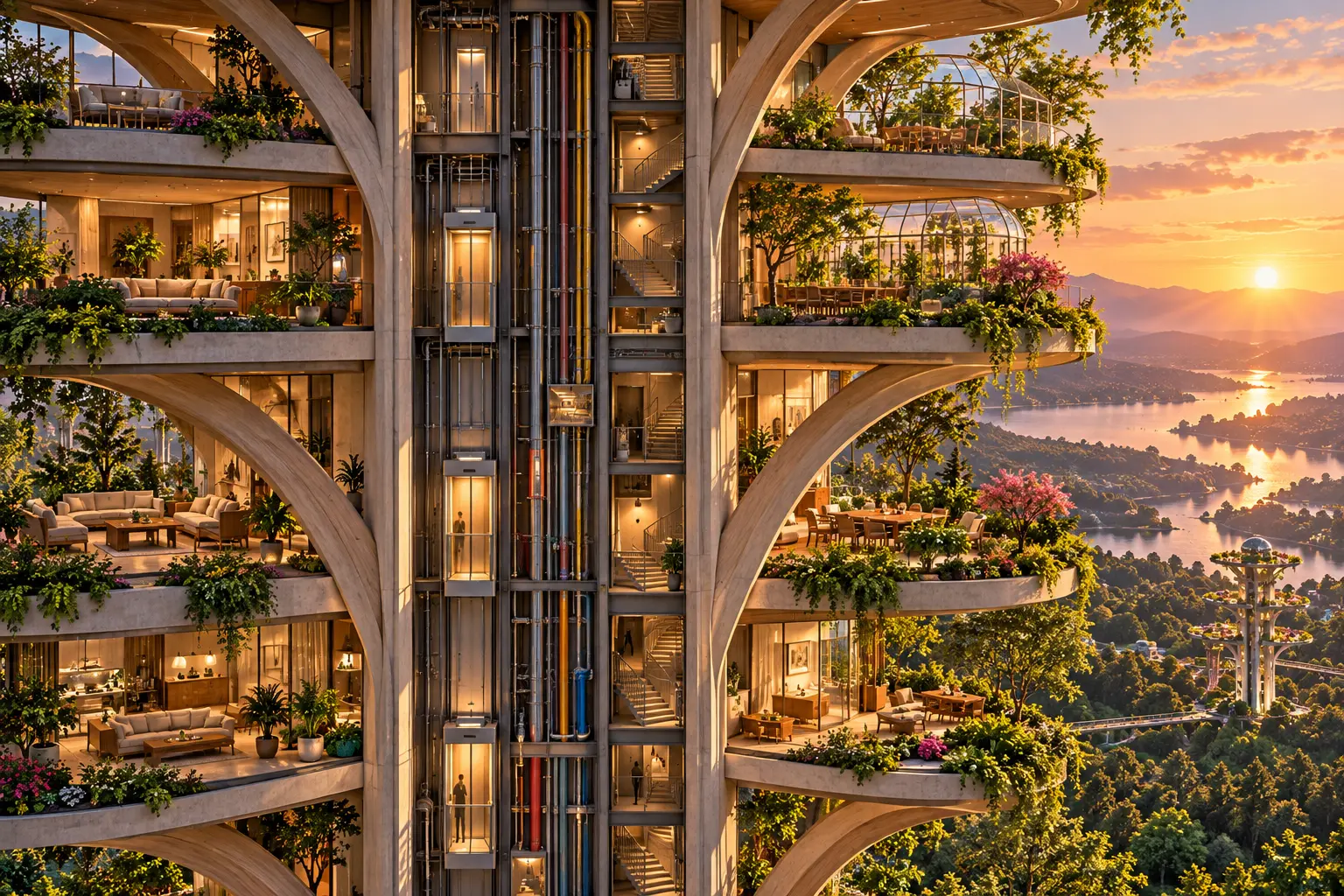
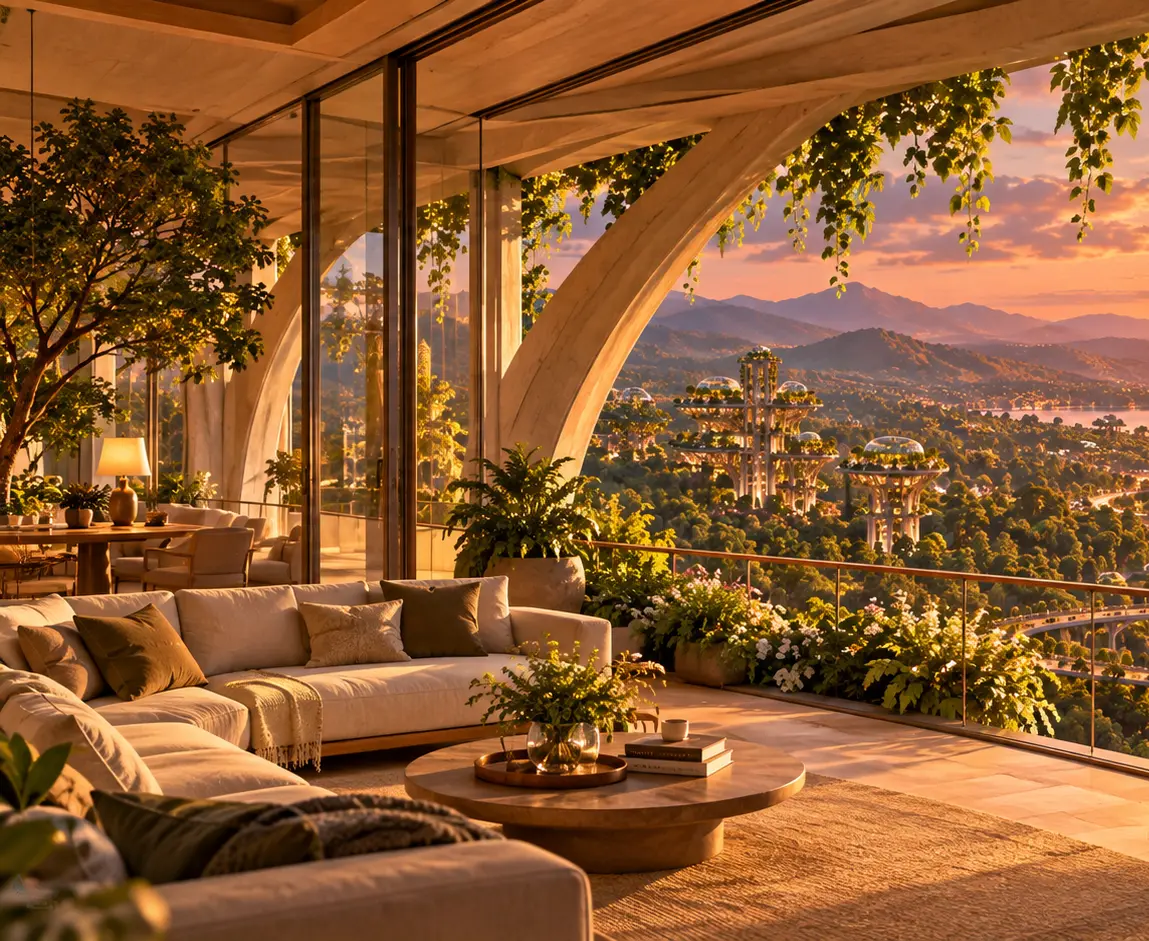
Substantial private residences extend from the central structure with direct access to gardens, terraces and greenhouse spaces. Families have privacy without being isolated from the people around them.

The architecture can adapt to different households and different stages of life. Parents, children and grandparents might occupy separate homes within the same tree, close enough to share life without surrendering independence.

The branches do not need to form identical stacked floors. They can shift and rotate as the structure rises, opening views and sunlight while maintaining a balanced, buildable structural rhythm.

04

Living With Nature

Nature is not decoration. It is part of the home.

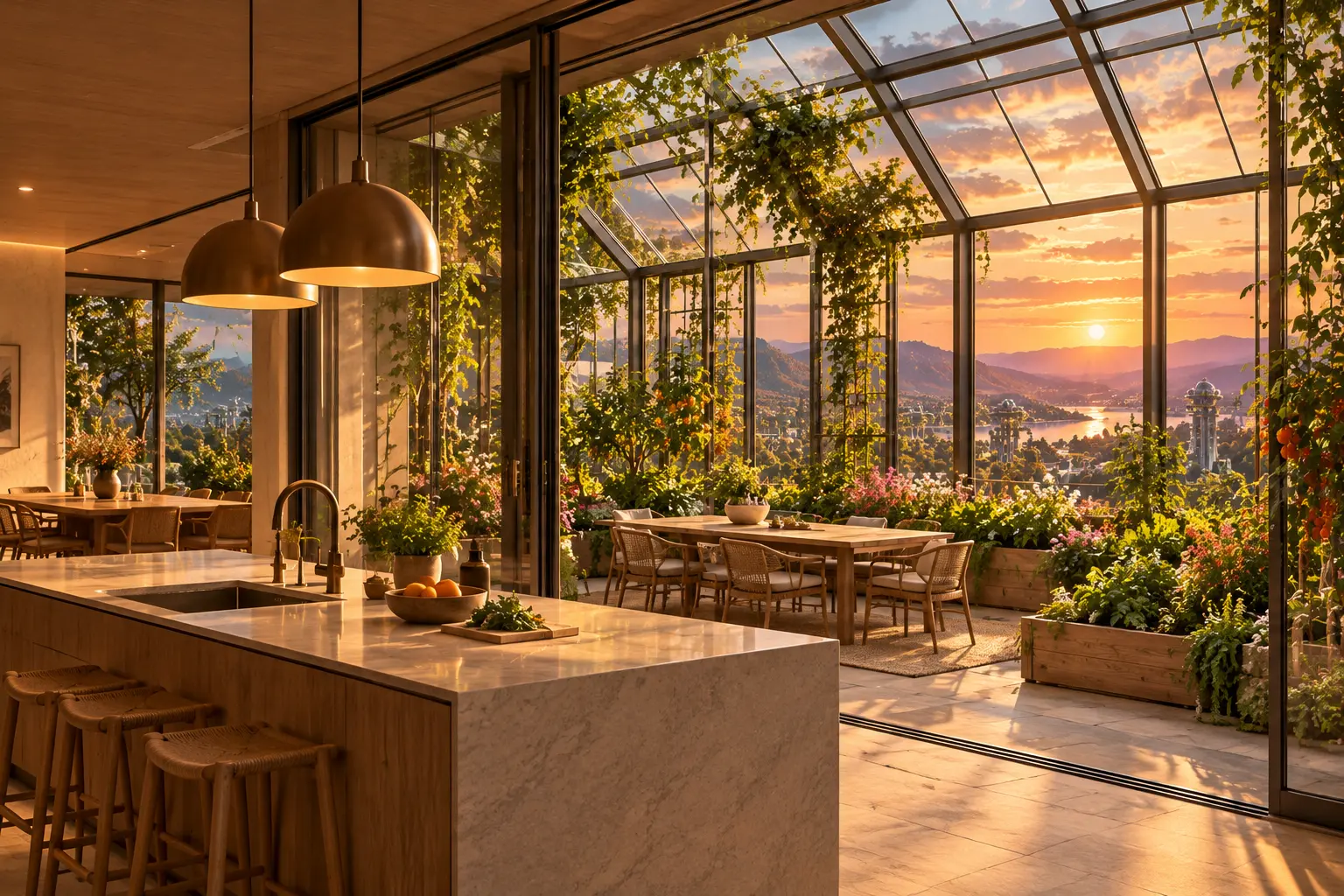
Trees, gardens and food-growing spaces surround the places where people live. Greenhouses extend the growing season and create beautiful semi-conditioned spaces between indoors and outdoors.

A kitchen might open directly into a greenhouse. A bedroom might look across a private garden instead of another building. Shared paths wind through vegetation rather than enclosed corridors.

Density should bring us closer to nature, not farther away from it.

05

The Trunk

A permanent backbone for a place that can change.

The central core carries the major structural loads and provides vertical movement for people, freight and emergency access. Secondary structural and service pathways can distribute utilities throughout the tree.

Around that permanent backbone, living spaces can be designed with greater flexibility. Homes can change as families grow, shrink and span generations.

The goal is not architecture that requires imaginary technology. It is a new arrangement of structural systems, materials and building technologies we already understand.

06

Water, Air & Energy

Let the building work with its environment.

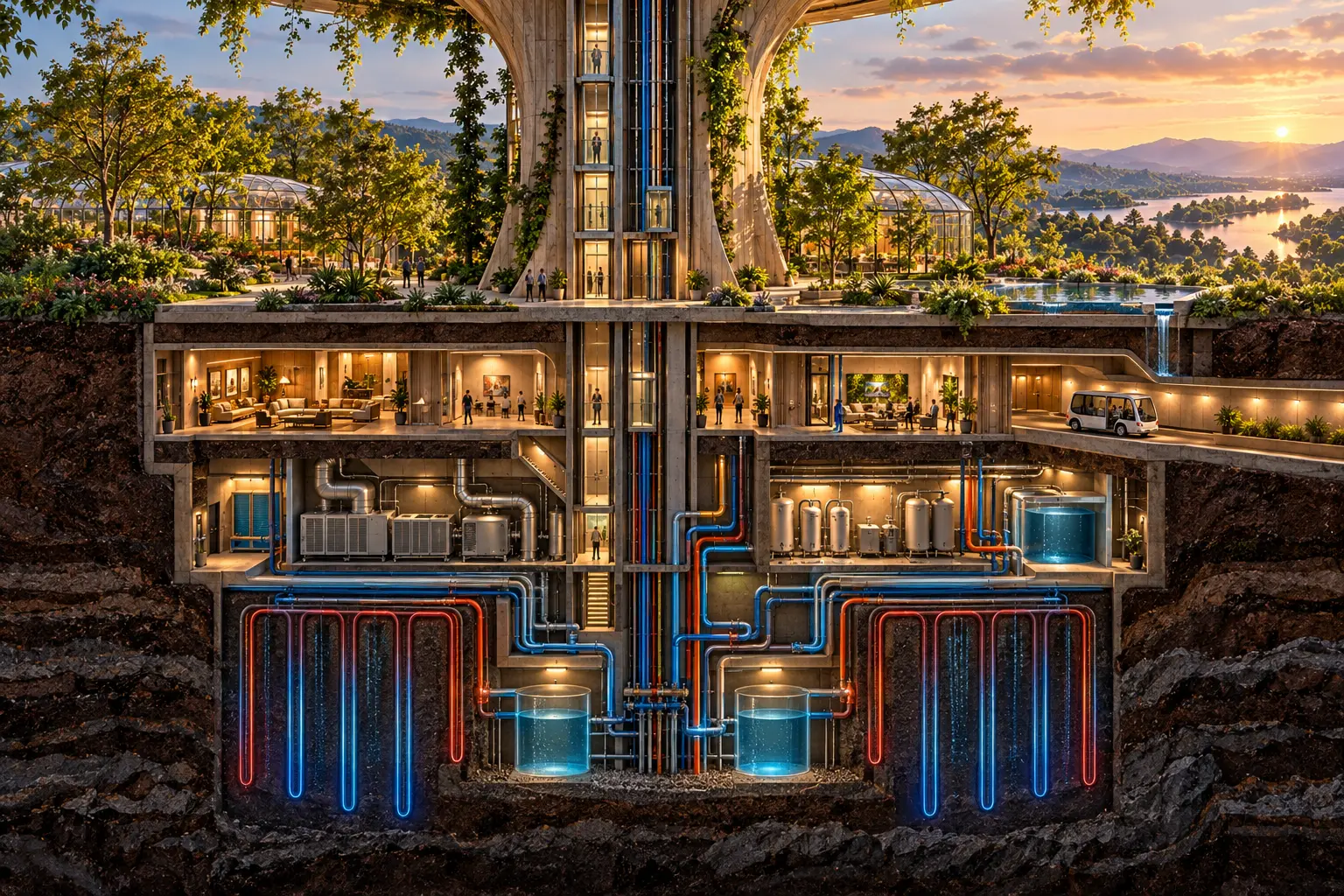
Ground-source systems could use the stable temperature beneath the surface to reduce the energy required for heating and cooling. Greenhouses and transitional spaces could create multiple climate zones rather than forcing every square foot to remain at the same temperature.

Rainwater can be captured, stored and reused for irrigation. Waste heat can be recovered. Solar energy, efficient electrical systems and future technologies can integrate into a shared infrastructure instead of being duplicated house by house.

The exact systems will change with climate and geography. The principle does not: use technology to make the visible world feel more natural, not less.

07

Give the Ground Back.

What happens between the buildings may matter more than the buildings themselves.

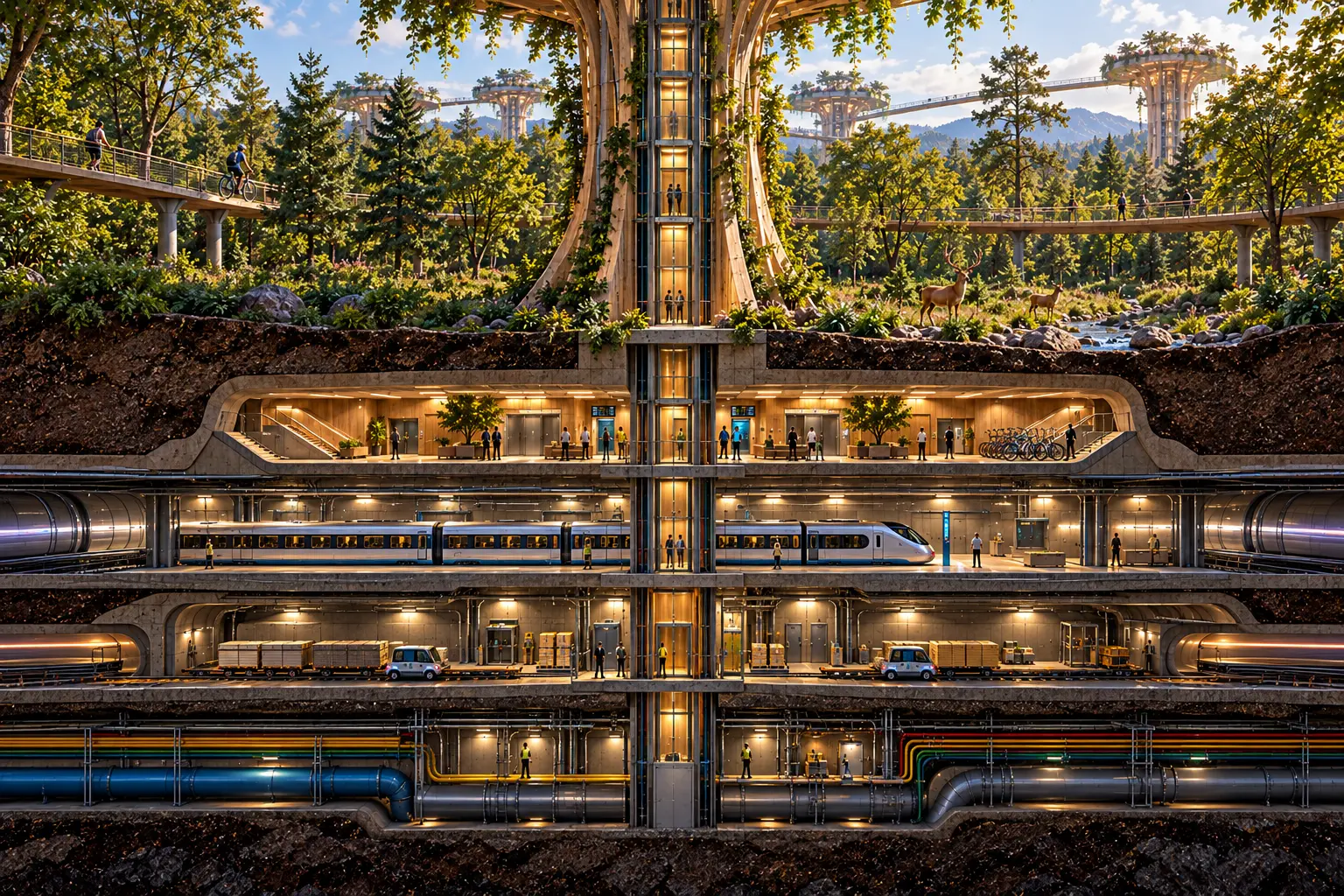
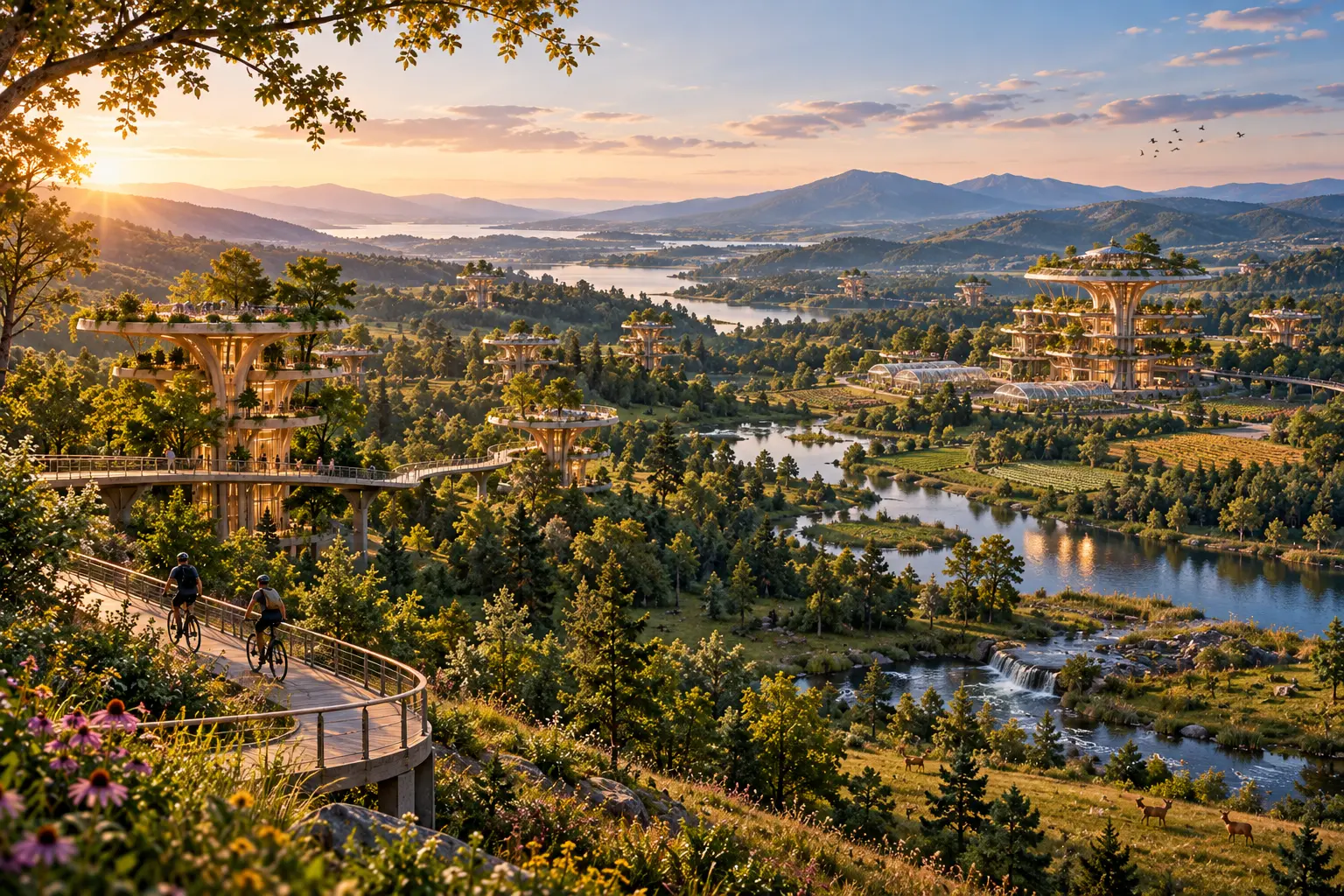
Forests remain forests. Streams remain connected. Wildlife can move across the landscape. People travel through gardens, meadows and trails instead of parking lots and multilane roads.

Walking, bicycles and small mobility devices handle much of the movement at the surface. Buildings occupy concentrated footprints so that the land between them can remain open, useful and alive.

08

The Roots

Put infrastructure beneath the landscape so life can flourish above it.

Below the surface, shared systems can carry water, electricity, communications and other utilities between communities. Geothermal systems exchange energy with the earth beneath them.

Passenger transit and freight could also move below the landscape where practical, connecting homes, civic centers and surrounding regions without requiring roads to divide everything above.

Cars do not have to disappear from the world. They simply stop defining it.

09

A Landscape of Communities

Not one enormous city. Not endless identical towers. A landscape of places shaped by the people and geography around them.

Some trees might serve a single extended family. Others could become larger residential communities. Civic trees might contain schools, medical care, shops, restaurants, workplaces and gathering spaces.

Their size, spacing and architecture should respond to the landscape rather than overwhelm it. From a distance, human settlement becomes a collection of carefully placed landmarks rising through a largely continuous natural environment.

10

Share the View.

This isn't a blueprint.
It's a view.

A view of a future where living closer together does not mean living farther from nature. Where children can explore without crossing traffic. Where generations of a family can live near one another without surrendering independence. Where density creates open space instead of consuming it.

We don't expect this exact vision to be the answer. We hope it helps someone imagine an answer.

If you can see it too, share the view.

11

Help Shape the View.

Architect, engineer, planner, builder, researcher, artist or simply someone with an idea? We'd like to hear what you see.

Sharing the View is an open vision. Questions, criticism, ideas and entirely different interpretations are welcome.